

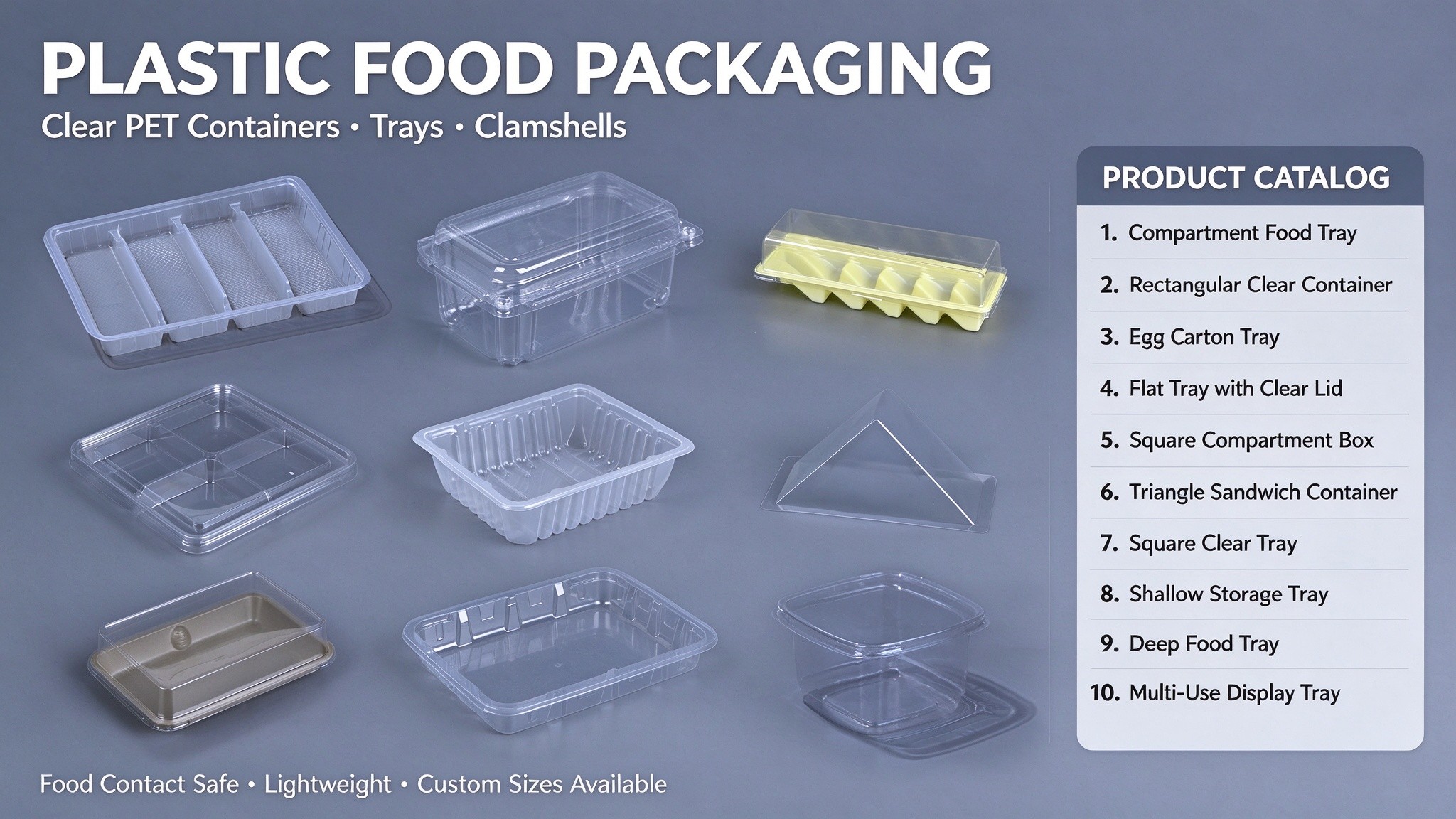
For a custom PP food tray manufacturer, the most reliable projects start with a clear specification—not only a request for a mold. The tray must fit the food, filling process, cover or film, outer carton and distribution plan. Sharing the right information early helps the supplier review compartments, PP sheet, thermoforming, tooling, sampling and commercial requirements together.
This guide explains the practical decisions a buyer should confirm before requesting a quotation. For a starting point, review the PP food tray and Plastic Blisters category, then compare the construction of real products such as TMSX-2233 and TMSX-2556.
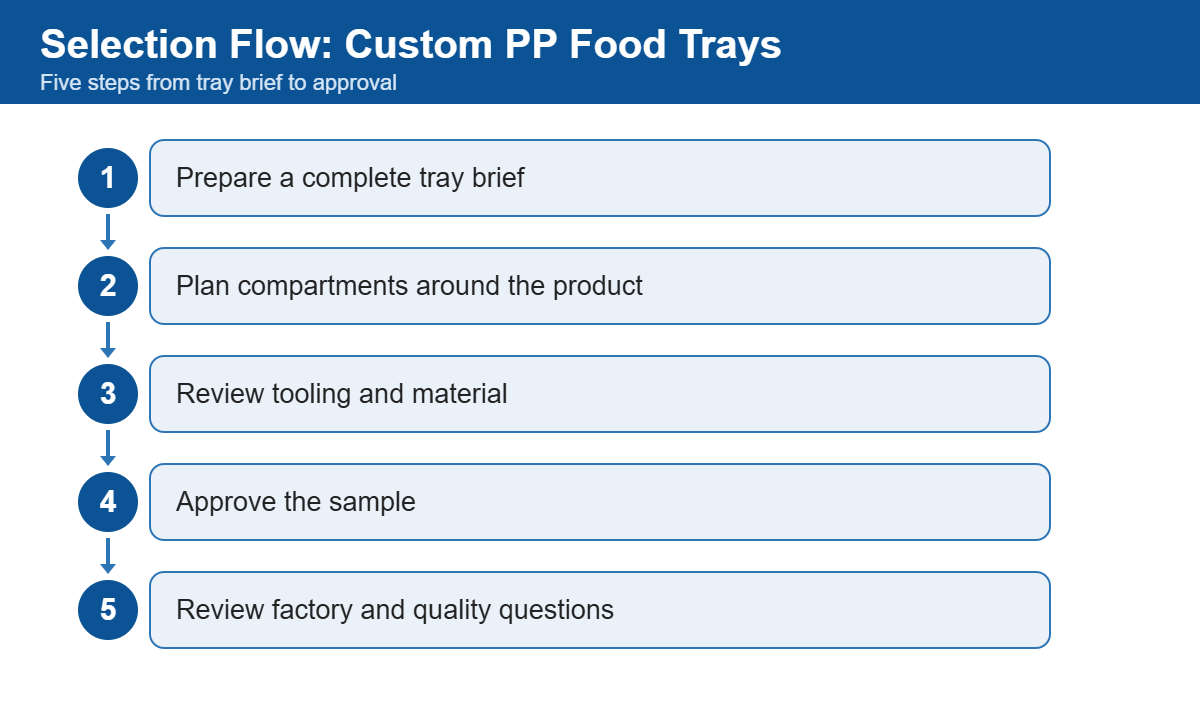
1. Start with a complete tray brief
Before discussing tooling, provide the food dimensions, quantity per tray, target tray dimensions, cavity arrangement, product weight and handling conditions. If the tray will use a lid, film, sleeve or outer carton, include those details from the beginning. A sketch, technical drawing or reference sample is useful, but measurable requirements still need to be confirmed.
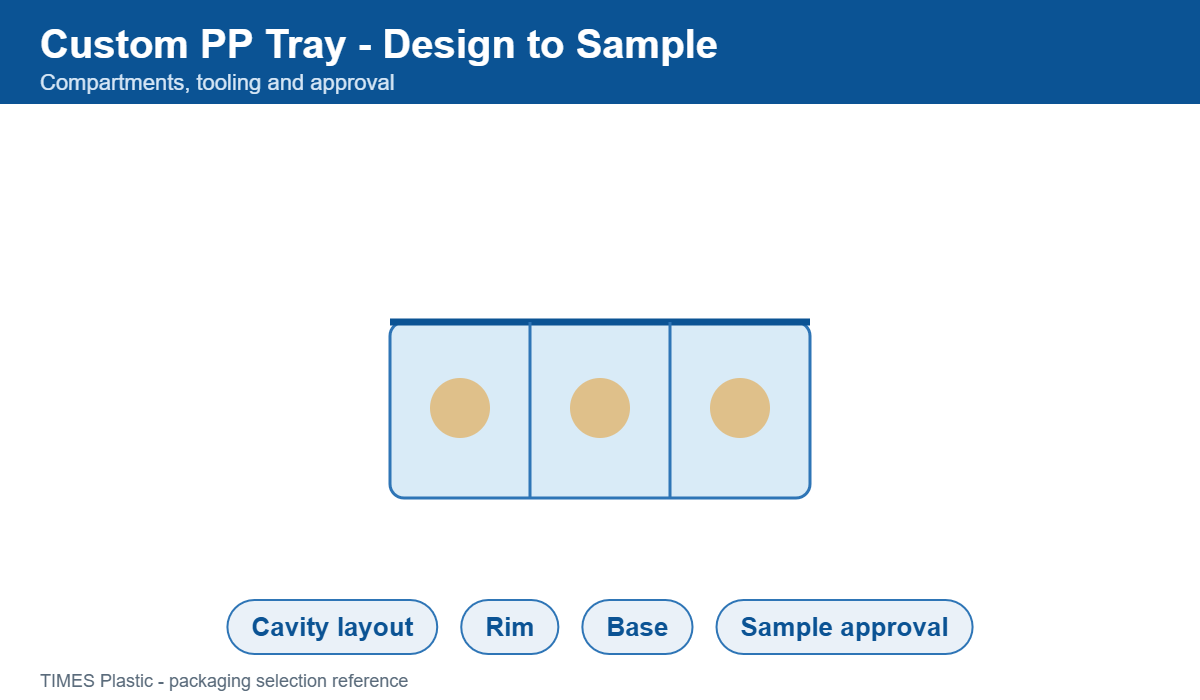
For a multi-compartment food tray, specify the number of cavities, each cavity’s length and width, wall spacing, access area, rim geometry and any separation required between foods. Also state whether the buyer needs a new design or is evaluating an existing structure. These details make a quotation more comparable and reduce assumptions.
2. Design compartments around the product and operation
Compartments can separate foods, organize a ready meal and improve retail presentation. More cavities can also affect tooling complexity, nesting, filling speed, product movement and packing efficiency. The best layout balances food fit and protection with practical thermoforming and packing.
Ask the supplier to review whether every cavity can be formed consistently and trimmed cleanly. Review the rim and base for stacking, labels, film or lid interaction, and outer-carton loading. Test the proposed layout with the real food where possible; an empty-tray review may not reveal movement, clearance or filling issues.
3. Confirm the PP sheet and thermoforming route
Record the PP sheet requirements in the specification: material grade or approved material description, sheet thickness or thickness range, colour, surface requirements and any buyer-supplied material constraints. Do not assume that a drawing alone defines the material. The approved sheet and the formed result should be checked against the project requirements.
TIMES Plastic presents PP sheet extrusion and thermoforming capabilities. Coordinating sheet production with thermoformed tray production may simplify communication, but the final result depends on the approved material, mold, forming parameters, trimming method and order requirements. Request the applicable details rather than relying on a general capability statement.
4. Treat tooling as a defined commercial item
A custom tray may require a new mold, while an existing structure may suit a project with limited changes. The quotation should state the tooling arrangement, design-review steps, what is included, sample timing assumptions and how design changes could affect cost or schedule. Confirm who owns the approved drawing and how revisions are recorded.
For an accurate quotation, provide the tray drawing or reference sample, cavity count, dimensions, material expectations, estimated order quantity, packing requirements and destination or shipping assumptions requested by the supplier. Ask the manufacturer to separate tooling, sample and unit-price information where practical. MOQ should be confirmed for the selected structure and material; it should not be inferred from another product.
5. Make sample approval a decision gate
The first sample should be reviewed with the real food and intended outer package whenever practical. Check cavity fit, product movement, stacking, nesting, lid or film interaction, label position, carton loading and the visual finish. Record deviations and required changes before the production specification is frozen.
An approval record can include the model reference, drawing revision, PP sheet description, dimensions, sample date, approved changes, packing method and inspection requirements. Keep the approved sample or reference images with that record. This creates a clear basis for repeat orders or a future size variation without treating an unapproved sample as a final production standard.
6. Ask focused factory and quality questions
Ask how the supplier controls incoming or extruded sheet, mold changes, thermoforming parameters, trimming, dimensional inspection, packing and batch records. Agree which dimensions and appearance points will be checked, the sampling method and how non-conforming trays will be handled. The inspection plan should match the buyer’s actual risks and packing line.
If documentation is relevant to the purchase, request current BRC, ISO 9001 or ISO 22000 documents and review their applicable scope and validity. This article does not treat a general certificate or capability statement as a product-specific performance, food-contact, regulatory or customer guarantee. The buyer should complete its own approval process for the intended market and application.
7. Build a quotation and MOQ checklist
A useful quotation should identify the tray model or drawing revision, PP sheet specification, dimensions and tolerances where agreed, cavity layout, tooling charges, sample charges, unit price basis, MOQ, packing method and payment or shipping terms. Confirm whether prices are based on a trial quantity, repeat order or a particular annual volume.
Ask what information is still missing before the supplier can quote. A clear list of open points is more useful than an unsupported promise of price or delivery. Confirm the commercial terms again after sample approval because a change in material, tooling, packing or quantity may change the quotation.
FAQ
Does every custom PP tray require a new mold?
Not every project does. An existing structure may be suitable, but a new mold is normally considered when the dimensions, rim or cavity layout are new. The supplier should confirm suitability against the buyer’s drawing and intended use.
What information is most important for tooling?
Food dimensions, cavity count, tray dimensions, wall structure, material expectations, packing requirements and the intended handling route are essential. A drawing or reference sample helps the supplier identify missing information.
Can a tray have different compartments?
Selected projects may support multiple cavity layouts. The design should be reviewed for forming, trimming, nesting, filling and packing rather than judged only from a drawing.
How should MOQ and quotation be confirmed?
Ask for MOQ and pricing against the exact model, material, tooling status, quantity basis and packing method. Do not transfer terms from another tray or product without written confirmation.
When should mass production begin?
After the buyer has reviewed the approved sample, drawing, material, inspection points, packing method and commercial terms. Any open changes should be documented before production is authorized.
Request the next step
Send your food dimensions, tray layout, cavity count, target quantity, PP sheet expectations and drawing or reference image. TIMES Plastic can review the custom PP food tray project and outline the next steps for tooling, samples, inspection, packing, MOQ and quotation. For a direct inquiry, use the Contact page; buyers can also consult the product catalog before sharing a brief.